Grade 6 - Session 6: “Investigating Buoyancy”
Session Architect: Aleeza Ayaz - Markhor3D
Session Length: 50-60 minutes
Session Overview:
In this session, students will explore the concept of buoyancy, the upward force exerted by a liquid on submerged objects. They will dive into Archimedes’ Principle, learning that the buoyant force equals the weight of the liquid displaced by an object. Through hands-on experiments, students will measure the displaced water volume for objects of different shapes and sizes, observing how this relates to buoyant force and whether objects float or sink. Using a load cell, they will measure the weight of objects before and after immersion, gaining insights into how buoyancy impacts an object’s apparent weight. This engaging session will connect science to real-world phenomena like floating boats and sinking stones.
Learning Objectives:
In this session, students will:
- Understand buoyancy as the upward force exerted by a liquid on an object submerged in it.
- Explore Archimedes’ Principle, learning that the buoyant force on an object is equal to the weight of the liquid displaced by the object.
- Measure the displaced water volume when objects of different shapes and sizes are submerged in water and understand how this relates to buoyant force.
- Learn how the relationship between weight and the volume of displaced water affects whether an object floats or sinks.
- Use the load cell to measure the weight of objects before and after immersion to observe changes due to buoyancy.
Teacher Resource:
Session File: ML66.plf (57.8 KB)
Equipment Required:
- MeasureLab with a built-in load cell to measure the weight of objects.
- A beaker or large container filled with water for submersion.
- A graduated cylinder or measuring cup to measure the volume of displaced water.
- Objects of different shapes, sizes, and materials (e.g., metal block, plastic ball, wooden block, etc.).
- Worksheet for recording measurements and observations.
- Pens, pencils, markers, etc.
Teaching Aids:
- Visual aids or diagrams showing buoyant force, displacement, and how objects float or sink.
- Projector (optional) to show examples of large objects like ships floating.
Preparation:
This step has to be done before the session on each workstation/apparatus by the teacher/session instructor:
- Make sure that each computer has Physlogger installed and can detect the Measrelab when connected to it using the provided cable.
- Each Measurelab should have access to a power outlet for sensors that require external power. For this session, we will use the loadcell which does not need external power.
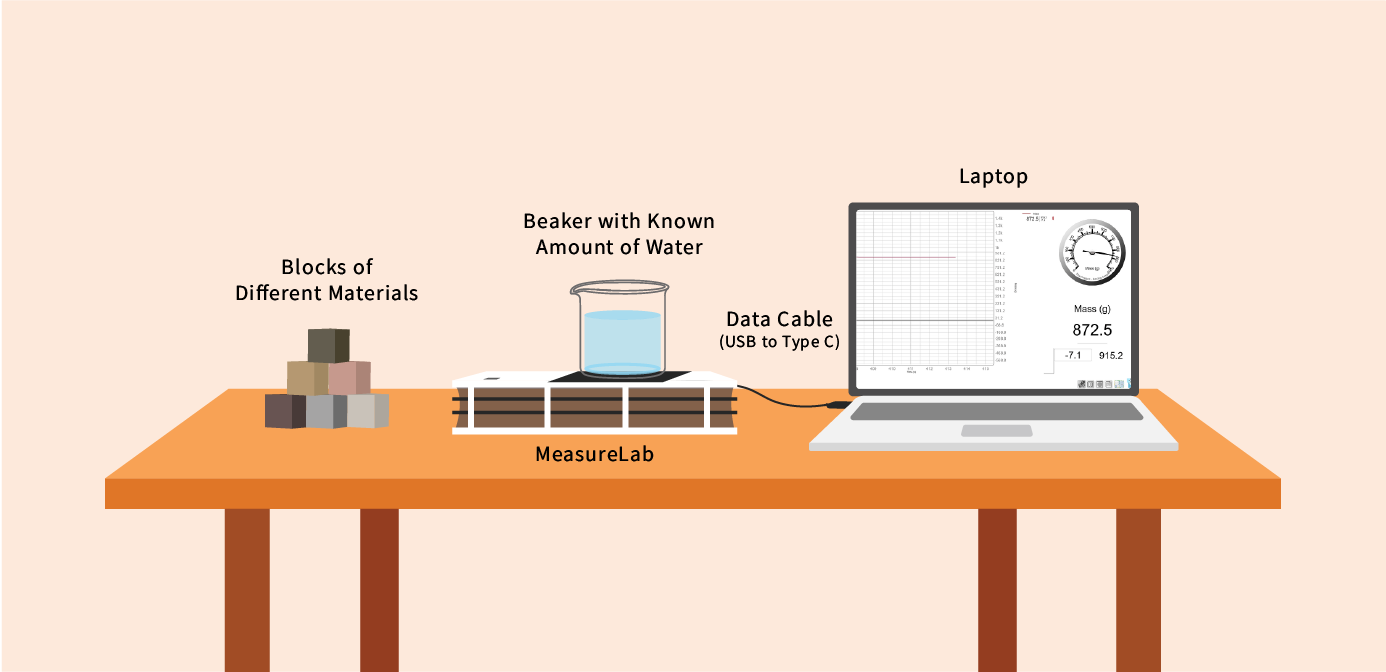
- Connect the Measurelab to your computer and open the provided session file.
- Your setup will look like this:
Introduction and Hands-On Exploration (35 minutes)
Engaging Students with Everyday Examples of Buoyancy:
- Start with a visual demonstration:
Show a picture of a large ship and ask:
“This is a huge ship made of heavy metal. Why do you think it floats on water instead of sinking?”
-
Allow students to respond with their thoughts (they might mention weight, size, or shape).
-
You may explain:
“That’s because of buoyancy! The water pushes up on the ship with a force. Today, we’ll explore how this works by measuring the weight of objects and how much water they displace when we put them in water.”
What is Buoyancy?
- Ask students:
“Have you ever noticed that some things float in water, like a piece of wood or a plastic bottle? But other things, like a metal spoon, sink? Why do you think that happens?”
-
Let students share their ideas about why objects float or sink.
-
Explain buoyancy:
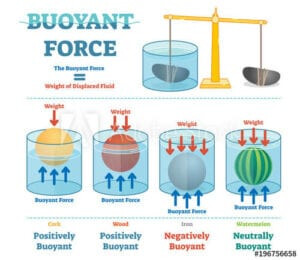
“When we put something in water, the water pushes up on it with a force called buoyancy. If the force of buoyancy is greater than the weight of the object, the object floats. If the weight of the object is too heavy for the buoyant force to support, it sinks.”
Step 1: Measuring the Weight of Objects (Using the Load Cell)
- Ask students:
“Let’s measure the weight of some objects before we put them in water. Do you think the heavier ones will float or sink?”
- Measuring Weight with the Load Cell:
- Place the first object (e.g., a metal block) on the load cell and record its weight.
- Repeat for other objects (e.g., plastic ball, wooden block).
Recording Data:
| Object | Weight (g) |
|---|---|
| Metal Block | |
| Plastic Ball | |
| Wooden Block |
Step 2: Observing Displacement and Buoyancy
- Explain displacement:
“Now, we’re going to put each object in water and see how much water it pushes out. The more water it pushes out, the bigger its volume. You can find how much water is pushed by measuring the water level before putting the object and after putting it inside the beaker.”
- Ask students to predict:
“What do you think will happen when we place the metal block in the water? Will it sink or float? What about the plastic ball?”
- Procedure for Water Displacement:
- Fill the beaker with a known amount of water.
- Place the metal block in the water and measure how much water is displaced by reading the change in water level using the graduated cylinder.
- Repeat the process with other objects.
Recording Data:
| Object | Initial Water Level (mL) | Final Water Level (mL) | Displaced Water (mL) |
|---|---|---|---|
| Metal Block | |||
| Plastic Ball | |||
| Wooden Block |
Step 3: Analyzing the Relationship Between Weight, Volume, and Buoyancy
- Ask students:
“Did the objects with more volume push out more water? Why do you think that is?”
- Explain Archimedes’ Principle:
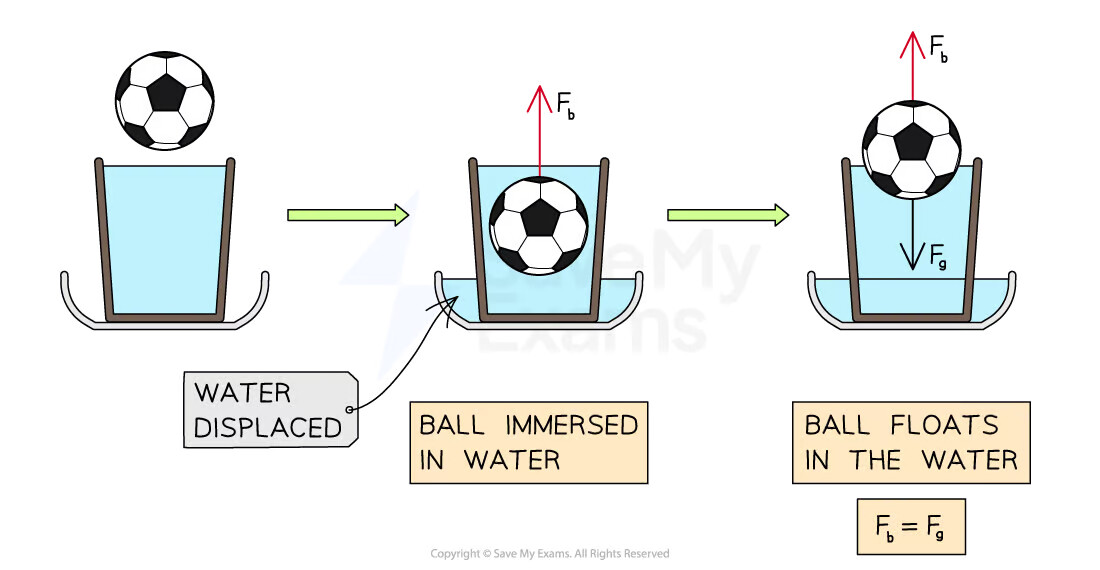
“Archimedes’ Principle tells us that the buoyant force on an object is equal to the weight of the water it displaces. So, if an object displaces a lot of water, it has a bigger buoyant force helping it float.”
- Converting Displaced Water to Weight:
- Explain that 1 mL of water equals 1 gram (since the density of water is 1g/mL).
- Students can estimate the buoyant force by calculating the weight of the displaced water in grams. This weight gives an idea of the buoyant force acting on the object.
Guided Activity and Worksheet (15-20 minutes)
Worksheet Table:
| Object | Weight (g) | Displaced Water (mL) | Buoyant Force (g) | Floats or Sinks |
|---|---|---|---|---|
| Metal Block | ||||
| Plastic Ball | ||||
| Wooden Block |
Discussion:
- Ask students:
“Did the objects that displaced more water float or sink? Why do you think that is?”
- Let students reflect on their findings:
- “If the buoyant force (displaced water’s weight) is greater than the object’s weight, it floats.”
- “If the object’s weight is greater than the buoyant force, it sinks.”
Reflection and Discussion (5-10 minutes)
Summarize:
“Today, we learned that objects float or sink based on how much water they displace. If they push out a lot of water, they get more help from buoyancy, and they might float!”
You may ask:
- “What surprised you the most about this experiment?”
- “Can you think of other examples of buoyancy, like when you float in a swimming pool?”
Glossary:
- Buoyancy: The upward force that liquids exert on objects, helping them float.
- Archimedes’ Principle: The rule that the buoyant force is equal to the weight of the liquid displaced by the object.
- Displacement: The amount of liquid pushed aside by an object.
- Force: A push or pull on an object.
- Volume: The amount of space an object takes up.