Grade 7 - Session 2: “Exploring Chemical Reactions and Conservation of Mass”
Session Architect: Aleeza Ayaz - Markhor3D
Session Length: 50-60 minutes
Session Overview:
In this session, students will investigate the Law of Conservation of Mass through a hands-on closed-system chemical reaction. Using MeasureLab and a pressure sensor, they will measure and analyze pressure changes caused by gas production in a sealed bottle. Students will observe how mass remains constant, even as gases form, connecting this to the principle of conservation. By analyzing data through graphs, identifying variables, and interpreting results, they will gain a deeper understanding of experimental design and the role of uncertainty in scientific experiments. This session emphasizes critical thinking and data analysis while demonstrating fundamental conservation principles.
Learning Objectives:
In this session, students will:
- Understand the Law of Conservation of Mass through a closed-system chemical reaction.
- Measure pressure changes during a reaction using the pressure sensor in MeasureLab.
- Observe gas production and its effects on pressure in a closed system.
- Analyze data through graphs and connect pressure changes to gas production.
- Discuss how mass remains constant even when gases are produced, linking it to conservation principles.
- Identify variables (independent, dependent, controlled) in the experiment and interpret the results.
- Discuss potential errors and the concept of uncertainty in scientific experiments.
- Use a graph to analyze how pressure changes over time during the reaction.
Teacher Resource:
Session File: ML72.plf (55.8 KB)
Equipment Required:
- PC/Laptop to display measurement and live plot
- MeasureLab with a built-in pressure sensor.
- Plastic bottle to keep the reaction isolated.
- Baking soda and vinegar for the reaction.
- Measuring spoons to control the amount of baking soda and vinegar.
- Stopwatch or MeasureLab’s timer for recording time intervals.
- Worksheet for recording data, graphing, and answering follow-up questions.
- Pens, pencils, markers, etc.
Teaching Aids:
- Visual aids: Diagrams explaining the Law of Conservation of Mass and gas production during reactions.
- Projector (optional).
Preparation:
This step has to be done before the session on each workstation/apparatus by the teacher/session instructor:
- Make sure that each computer has Physlogger installed and can detect the Measrelab when connected to it using the provided cable.
- Each Measurelab should have access to a power outlet for sensors that require external power. This session uses Pressure Sensor and Load Cell which, require external power source to be connected.
- Launch the Physlogger application and load the session file provided in the resources section.
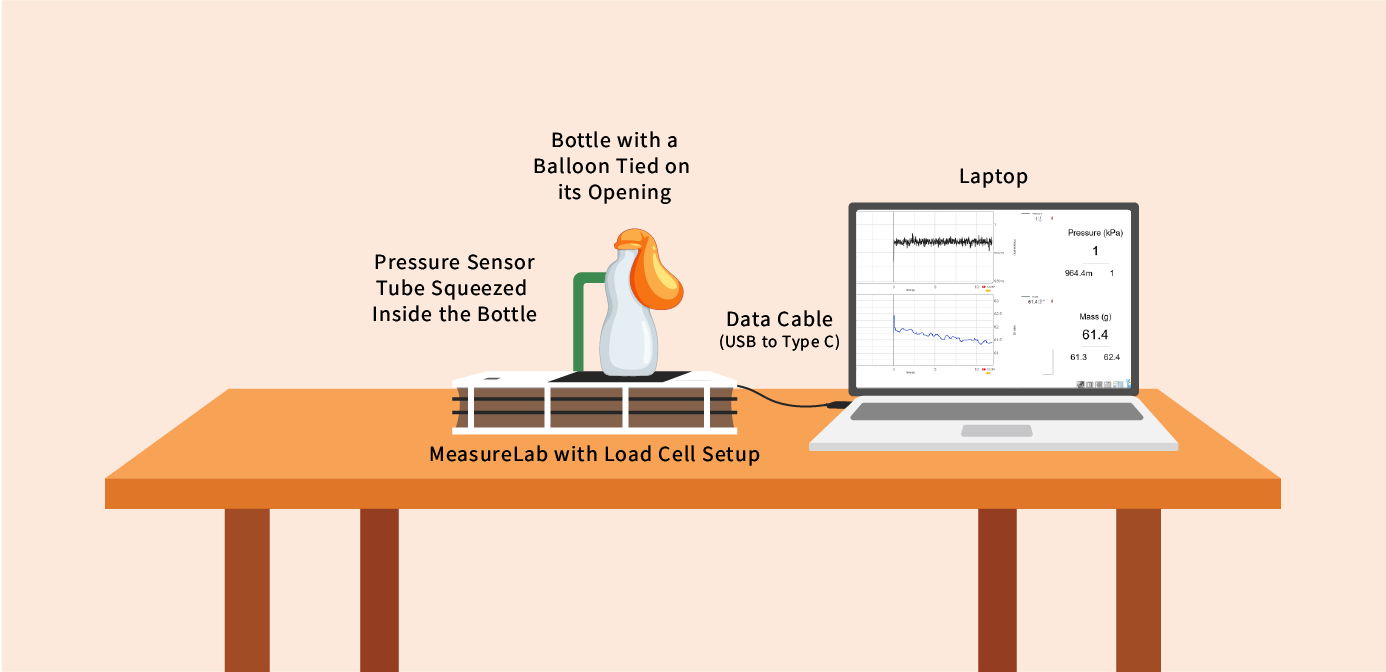
Your setup will look something like this:
Introduction and Hands-On Exploration: (30-35 minutes)
Engaging Students with Chemical Reactions:
- You may start by asking:
“Have you ever mixed baking soda and vinegar before? What did you see happen?”
-
Let students share their experiences of the bubbling reaction, guiding them toward the idea that gas is produced.
-
You may continue:
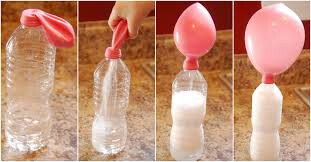
“When you mix baking soda and vinegar, the bubbles are actually a gas called carbon dioxide (CO₂). But what if we could capture that gas? What do you think would happen to the pressure inside a closed bottle?”
- You may explain:
“Today, we’ll observe what happens when we mix baking soda and vinegar inside a closed bottle. We’ll use MeasureLab’s pressure sensor to track how the pressure changes over time as the reaction produces gas. We’ll also see if the mass changes before and after the reaction.”
What is the Law of Conservation of Mass?
- You may ask:
“Who remembers what happens to the mass during a chemical reaction? Does it increase, decrease, or stay the same?”
-
Let students respond with what they know about mass, leading to the explanation:
-
You may explain:
“According to the Law of Conservation of Mass, the mass stays the same in a closed system, even though new substances (like gases) are formed. This is because the total amount of matter doesn’t change—it just changes form.”
Step 1: Setting Up the Experiment
- Preparing the Reaction:
- Measure a specific amount of baking soda and place it inside a small balloon to be attached to the end of a small bottle.
- Pour a controlled amount of vinegar into the bottle.
- You may ask:
“What do you think will happen when we mix these? What will happen to the pressure inside the closed bottle?”
- Attaching the Pressure Sensor:
- Seal the bottle with a rubber band around the balloon. Make a hole in the bottle and insert the pressure sensor tube inside the bottle. Make sure this hole is sealed tightly with tape to monitor changes accurately.
- You may explain:
“The pressure sensor will measure how much the gas from the reaction pushes against the walls of the bottle.”
- Measuring Initial Mass and Pressure:
- Record the initial mass of the bottle with the baking soda and vinegar separately, before they mix.
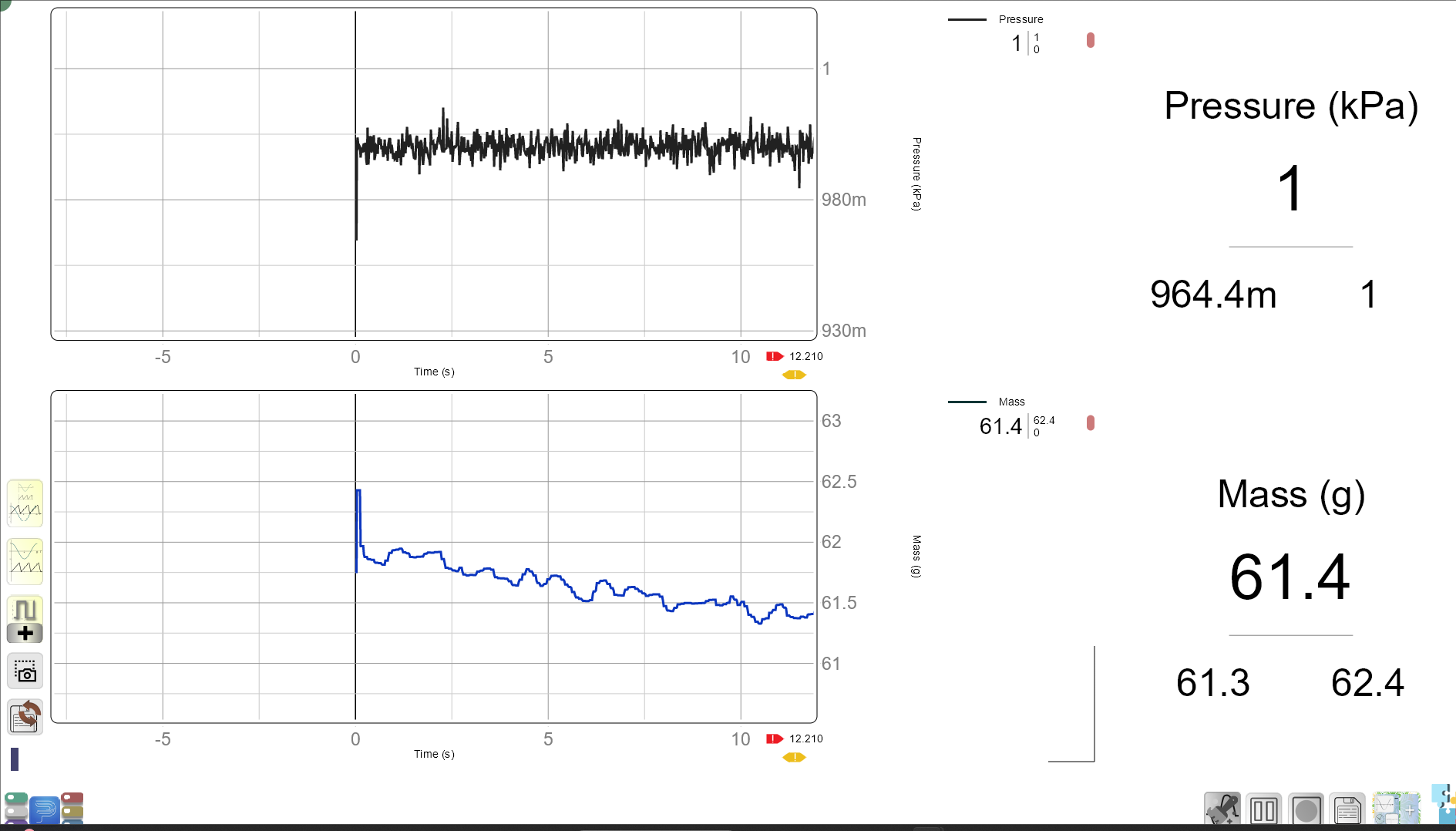
- Measure and record the initial pressure inside the bottle.
Step 2: Running the Experiment
-
Mix the Reactants:
- Lift the balloon and shake it so that the baking soda inside it is mixed with the vinegar inside the bottle.
- Start the timer and record pressure changes every 30 seconds.
- Lift the balloon and shake it so that the baking soda inside it is mixed with the vinegar inside the bottle.
-
Observing the Reaction:
- You may ask:
“What do you notice happening inside the bottle as the reaction occurs? What’s happening to the pressure?”
- Let students observe the bubbling reaction and watch how the pressure changes in real-time using MeasureLab’s live plot.
Worksheet Section
This worksheet helps students track the changes in pressure and mass during the experiment and also helps them graph their results.
Part 1: Recording Initial Mass and Pressure
| Substance | Initial Mass (g) |
|---|---|
| Vinegar | |
| Baking Soda |
| Time (Seconds) | Initial Pressure (atm) |
|---|---|
| 0 (Start) |
Part 2: Tracking Pressure Over Time
Record the pressure changes every 30 seconds. This shows how CO₂ production affects pressure in a closed system.
| Time (Seconds) | Pressure (atm) |
|---|---|
| 30 | |
| 60 | |
| 90 | |
| 120 | |
| 150 | |
| 180 (End) |
Part 3: Final Mass and Pressure
| Final Mass (g) |
|---|
| Final Pressure (atm) |
|---|
Part 4: Graphing Data
Using the pressure data collected over time, students will create a graph:
- x-axis: Time (seconds).
- y-axis: Pressure (atm).
Reflection and Follow-up Questions: (10-15 minutes)
After completing the experiment and recording data, students will answer the following questions:
Understanding Pressure Changes
-
What happened to the pressure inside the bottle as the reaction occurred?
- Did it increase steadily or change in another way?
-
Look at your graph. What pattern do you notice in the pressure over time?
- What might explain this pattern?
Conservation of Mass
-
Did the mass of the closed system change before and after the reaction?
- Why did the mass stay the same even though gas was produced?
-
Can you think of an everyday example where the mass stays the same, but pressure changes?
- Think about a balloon or a soda bottle.
Potential Experimental Errors and Uncertainty
- Identifying Potential Errors
- You may ask:
“Do you think there could have been any small errors during the experiment? For example, did any gas escape from the bottle, or did we measure the exact amounts of baking soda and vinegar each time?”
- Explaining Uncertainty
- Introduce the Concept of Uncertainty:
“In science, we sometimes talk about something called uncertainty. Uncertainty is a way of saying there might be a small amount of error or variation in our measurements. Even though we try our best to measure exactly, small things like a little gas escaping or slight differences in the amount of vinegar can affect our results a bit.”
- Discussing Impact of Errors on Results
- You may ask:
“How do you think a small amount of gas escaping could affect our data on pressure? Do you think it would make a big difference or just a small one?”
Gas and Pressure
- What caused the pressure to increase inside the bottle?
- How did the gas produced contribute to this change?
Summary and Wrap-Up: (5 minutes)
- You may summarize:
“Today, we observed how a chemical reaction produces gas and increases pressure in a closed system. We learned that even though the pressure changed, the mass stayed the same, showing us how the Law of Conservation of Mass works. We also talked about uncertainty, which reminds us that even in carefully set up experiments, tiny things can affect our measurements.”
Glossary:
- Conservation of Mass: The principle that the total mass in a closed system remains constant during a chemical reaction.
- Pressure: The force exerted by particles (like gas molecules) against the walls of a bottle.
- Gas Production: The release of gas as a product of a chemical reaction.
- Closed System: A system where no mass enters or leaves during a reaction.
- Uncertainty: A small amount of possible error in measurements that scientists account for.
- Carbon Dioxide (CO₂): A gas produced during reactions like the mixing of baking soda and vinegar.