Grade 7 - Session 6: Investigating Buoyancy and Archimedes’ Principle
Session Architect: Aleeza Ayaz - Markhor3D
Session Length: 50-60 minutes
Learning Objectives
In this session, students will:
- Understand buoyancy and Archimedes’ Principle through hands-on experimentation.
- Measure the volume of displaced water and relate it to the concept of buoyant force.
- Calculate the density of objects and compare it to the density of the liquid to determine buoyancy.
- Use the load cell to measure the weight of displaced water and compare it to the weight of objects.
- Identify independent and dependent variables in the experiment.
- Plot graphs to analyze relationships between weight, displacement, density, and buoyancy.
- Recognize proportional relationships between variables.
Equipment Required
- PC/Laptop to display measurement and live plot
- MeasureLab with a built-in load cell
- Various objects (e.g., metal cubes, wooden blocks, plastic objects) of different densities
- Beakers for measuring displaced water
- Containers filled with different liquids (e.g., water, saltwater, oil)
- Graduated cylinders for measuring displaced liquid
- Measuring tape or ruler for measuring dimensions of objects
- Worksheet for recording data and analyzing findings
- Pens, pencils, markers, etc.
Teacher Resource:
Session File: ML76.plf (57.8 KB)
Teaching Aids
- Visual aids: Diagrams of buoyancy, Archimedes’ Principle, and density
- Projector (optional) to display live data and real-world examples, like submarines or floating ships
Preparation:
This step has to be done before the session on each workstation/apparatus by the teacher/session instructor:
- Make sure that each computer has Physlogger installed and can detect the Measrelab when connected to it using the provided cable.
- Each Measurelab should have access to a power outlet for sensors that require external power. For this session, we will use the loadcell which does not need external power.
- Connect the Measurelab to your computer and open the provided session file.
- Your setup will look like this:
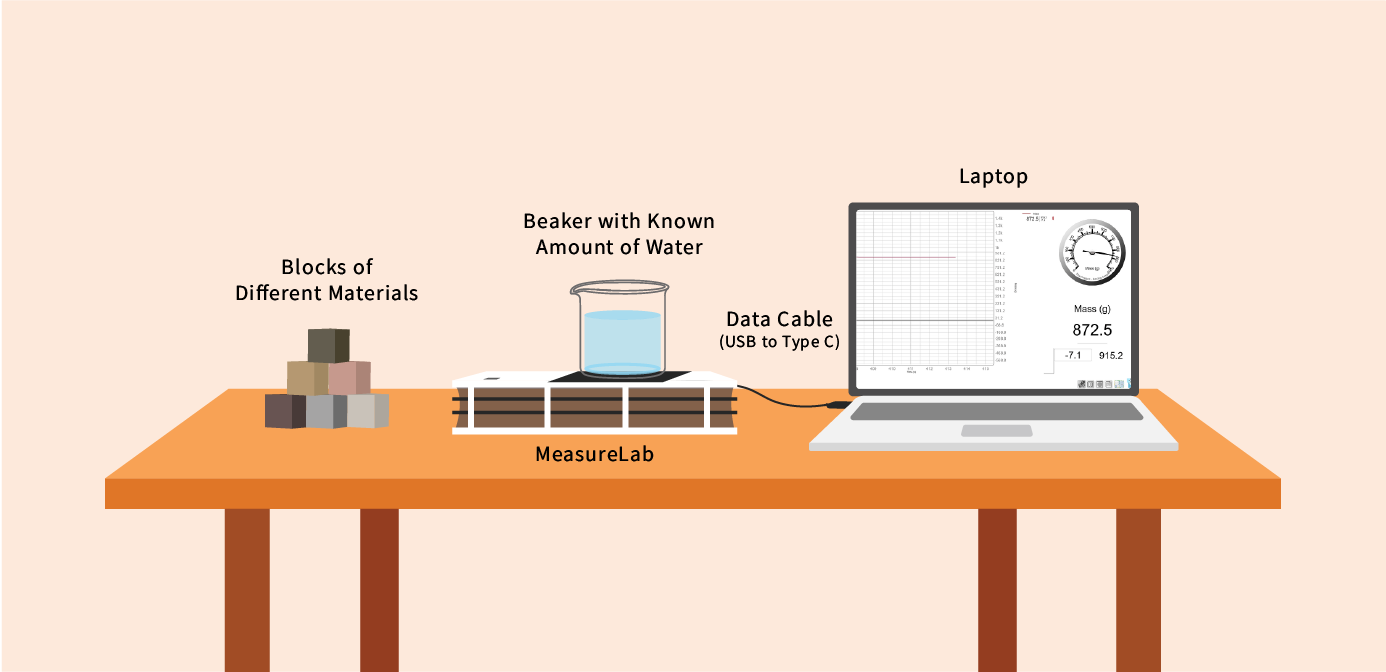
Introduction and Hands-On Exploration: (35 minutes)
Engaging Students with Everyday Examples of Buoyancy
- You may start by asking:
“Have you ever seen a ship floating on water? Why do you think such a big object can float while smaller objects like a rock sink?”
-
Show an image of a ship and a stone.
-
Let students share their thoughts, and they may suggest “the ship is hollow” or “the stone is solid.”
-
Build on their responses:
“This happens because of buoyancy—a force that pushes up on objects in water. Today, we’ll explore how this works using Archimedes’ Principle, which explains why objects float or sink.”
What is Buoyancy?
- You may ask:
“What do you think happens when we put an object in water? Does the water push back?”
-
Guide students to understand that water pushes up on objects, causing some objects to float.
-
You may explain:
“When an object is placed in water, it pushes the water out of the way. The water pushes back with a force called buoyant force. The more water an object displaces, the greater the buoyant force pushing back on it.”
Demonstration with Objects
Show a floating object (e.g., wood) and a sinking object (e.g., a metal cube).
- You may ask:
“Why do you think the wood floats, but the metal sinks?”
- Let students predict, then explain:
“The wood is less dense than water, so it floats. The metal is denser than water, so it sinks because it can’t displace enough water to balance its weight.”
- To connect density with buoyancy, start by asking:
“If I have a tiny rock and a big pillow, which one feels heavier? Why do you think that is?”
- Provide a Simple Explanation:
“Density is how tightly packed the material inside an object is. Even if two objects are the same size, the one with more tightly packed material will be heavier. This is why a small rock can feel heavier than a big pillow.”
- Real-Life Example - Icebergs:
“Ice floats because it’s less dense than water. This is why, even though icebergs are huge, they float in the ocean.”
What is Archimedes’ Principle?
- You may explain:
“Archimedes’ Principle tells us that the buoyant force on an object is equal to the weight of the liquid it displaces. If an object displaces more water, it will float. If it can’t displace enough water, it sinks.”
- Ask for real-life examples:
“Where do we see this in real life? Think about boats, submarines, or even hot air balloons.”
Step 1: Setting Up the Experiment and Measuring Displaced Water
Measuring the Object’s Weight
- Place an object (e.g., metal cube) on the load cell to measure its weight. Record this on the worksheet.
- Repeat this step with each object, noting each weight.
Data Table:
| Object | Weight in Air (g) |
|---|---|
| Metal Cube | |
| Wood Block |
Step 2: Calculating Density of the Objects
- Measure the volume of each object using a ruler or measuring tape. Calculate the density of each object using the formula:
Density = Mass/Volume - Record the calculated density for each object.
Data Table:
| Object | Weight in Air (g) | Volume (cm³) | Density (g/cm³) |
|---|---|---|---|
| -------- | -------------------- | --------------- | ------------------ |
Step 3: Measuring Displaced Water and Observing Buoyancy
- Fill a beaker or container with a known amount of water.
- Place each object in water and measure the amount of water it displaces by reading the water level before and after submersion.
- Use a graduated cylinder to collect the displaced water and measure its volume and weight.
- The amount of water displaced by the object will be equal to the volume of the object.
Data Table:
| Object | Initial Water Level (mL) | Final Water Level (mL) | Displaced Water Volume (mL) | Weight of Displaced Water (g) | Density of Liquid |
|---|
Guided Activity and Analysis
Identifying Relationships with Graphs
- Plot a graph: Students can graph the weight of the object on the x-axis and the volume of displaced water on the y-axis to examine how volume and weight correlate with buoyancy.
- Direct vs. Inverse Proportionality: Explain how to use the graph to determine which variables are directly or inversely proportional by observing the shape and slope of the line.
- You may guide students with questions:
“How did the displaced volume relate to the object’s weight and density?”
“Is there a pattern in your graph that helps us understand why some objects float while others sink?”
Reflection Questions
- “What happened when we placed different objects in water? Why did some float and others sink?”
- “How does the density of an object relate to its ability to float?”
- “How does changing the liquid affect the buoyancy of an object?”
- “Which of the variables (weight, volume, density) appear directly or inversely related to buoyancy?”
Summary of Key Learnings:
- Objects that displace a volume of water equal to or greater than their weight float; otherwise, they sink.
- Density is a critical factor in buoyancy, as less dense objects displace enough water to balance their weight.
- Archimedes’ Principle helps explain why ships, boats, and other large structures stay afloat.
Glossary
- Buoyant Force: The upward force exerted by a fluid, enabling objects to float.
- Archimedes’ Principle: A principle stating that the buoyant force on an object is equal to the weight of the fluid it displaces.
- Displacement: The amount of fluid pushed aside by an object when submerged.
- Density: Mass per unit volume, which affects whether an object will sink or float in a given fluid.