Grade 8 - Session 2: “Advanced Chemical Reactions & Conservation of Mass”
Session Architect: Aleeza Ayaz - Markhor3D
Session Length: 50-60 minutes
Learning Objectives:
In this session, students will:
- Understand the Law of Conservation of Mass in a closed system during a chemical reaction.
- Observe how reaction rates vary with temperature and analyze this effect.
- Collect and graph pressure data to relate temperature to reaction rates.
- Reflect on experimental uncertainty and its impact on measurements.
Teacher Resource:
Session File: ML82.plf (58.5 KB)
Equipment Required:
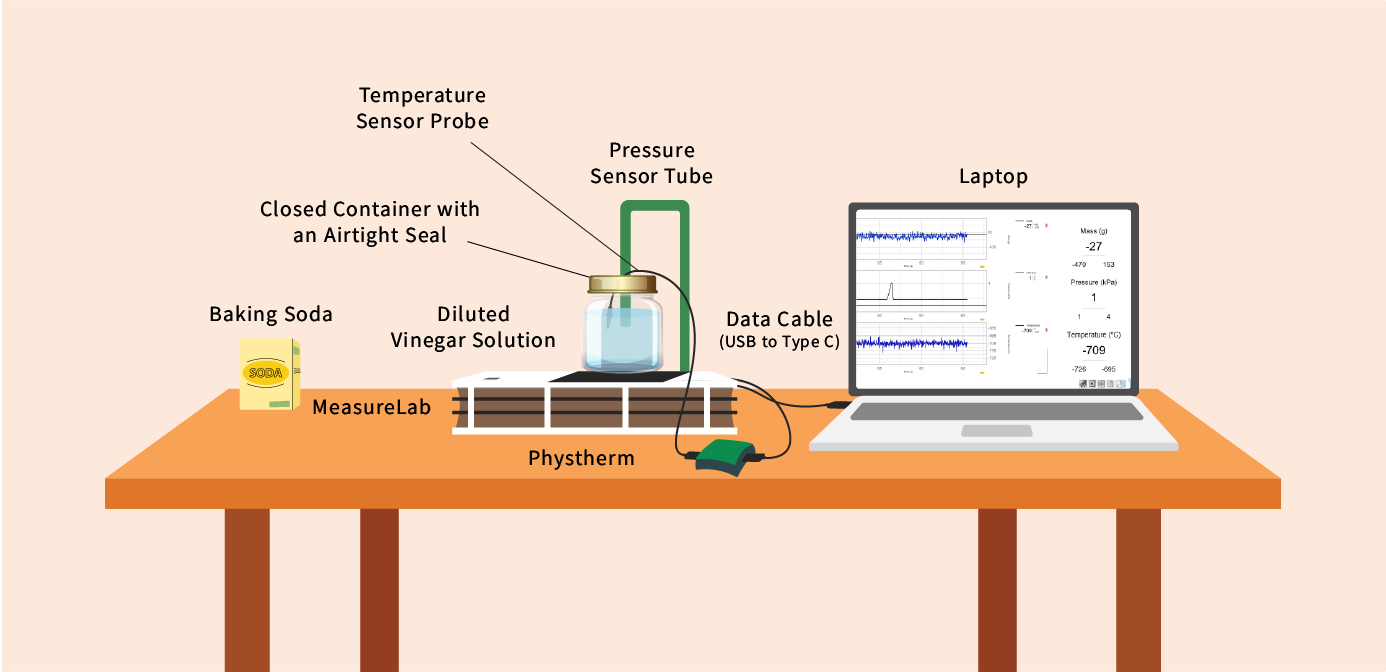
- MeasureLab with a built-in load, pressure (attached to tube) and temperature sensor (attached to probe).
- Closed container with an airtight seal (e.g., plastic or glass jar) to isolate the reaction.
- Diluted vinegar solution (50% vinegar, 50% water) for a controlled reaction rate.
- Baking soda as a reactant.
- Room temperature and warm water bath for varying temperature conditions.
- Measuring spoons and graduated cylinders for precise measurements.
- Stopwatch or MeasureLab’s timer.
- Worksheet for recording data, graphing, and answering reflection questions.
- Pens, pencils, markers, etc.
Teaching Aids:
- Visual aids: Diagrams explaining the Law of Conservation of Mass and gas production during reactions.
- Projector (optional).
Preparation:
This step has to be done before the session on each workstation/apparatus by the teacher/session instructor:
- Make sure that each computer has Physlogger installed and can detect the Measrelab when connected to it using the provided cable.
- Each Measurelab should have access to a power outlet for sensors that require external power. This session uses Pressure Sensor and Load Cell which, require external power source to be connected.
- Launch the Physlogger application and load the session file provided in the resources section.
Your setup will look something like this:
Introduction and Hands-On Exploration: (40-45 minutes)
- Introduce Reaction Rates in Simple Terms:
- You may start by asking:
“Have you noticed how some reactions, like when we bake or mix things, go faster or slower based on temperature or how much of each ingredient we use?”
- Allow students to discuss, then explain:
“Reaction Rate” is simply how fast or slow a reaction happens, which can be influenced by conditions like temperature or amount of each ingredient.
- Law of Conservation of Mass Review:
- You may ask:
“Who remembers what happens to mass during a reaction in a closed container? Does it change or stay the same?”
- Guide them to recall that in a closed system, mass stays constant. Although gas is produced, it remains in the container, so the total mass doesn’t change.
- Introduce Experiment Goals:
- Explain that they will explore how temperature affects reaction speed (rate) by tracking changes in pressure over time in a closed system, helping them see conservation of mass in action.
Step 1: Setting Up the Experiment
-
Assign Temperature Conditions:
- Divide students into two groups, each with a temperature condition: room temperature or warm water bath.
-
Preparing Diluted Vinegar Solution:
- Use a 50:50 dilution of vinegar to water. Slightly increase the volume to ensure adequate CO₂ production, such as using 15-20 mL of diluted vinegar.
-
Guiding Students to Identify Variables:
- You may ask:
“What are we changing in each group, and what are we measuring?”
- Guide students to identify:
- Independent Variable: Temperature of the reaction environment.
- Dependent Variable: Pressure change over time.
- Controlled Variables: Amount of baking soda and diluted vinegar, sealed container setup.
- Measure Initial Mass and Pressure:
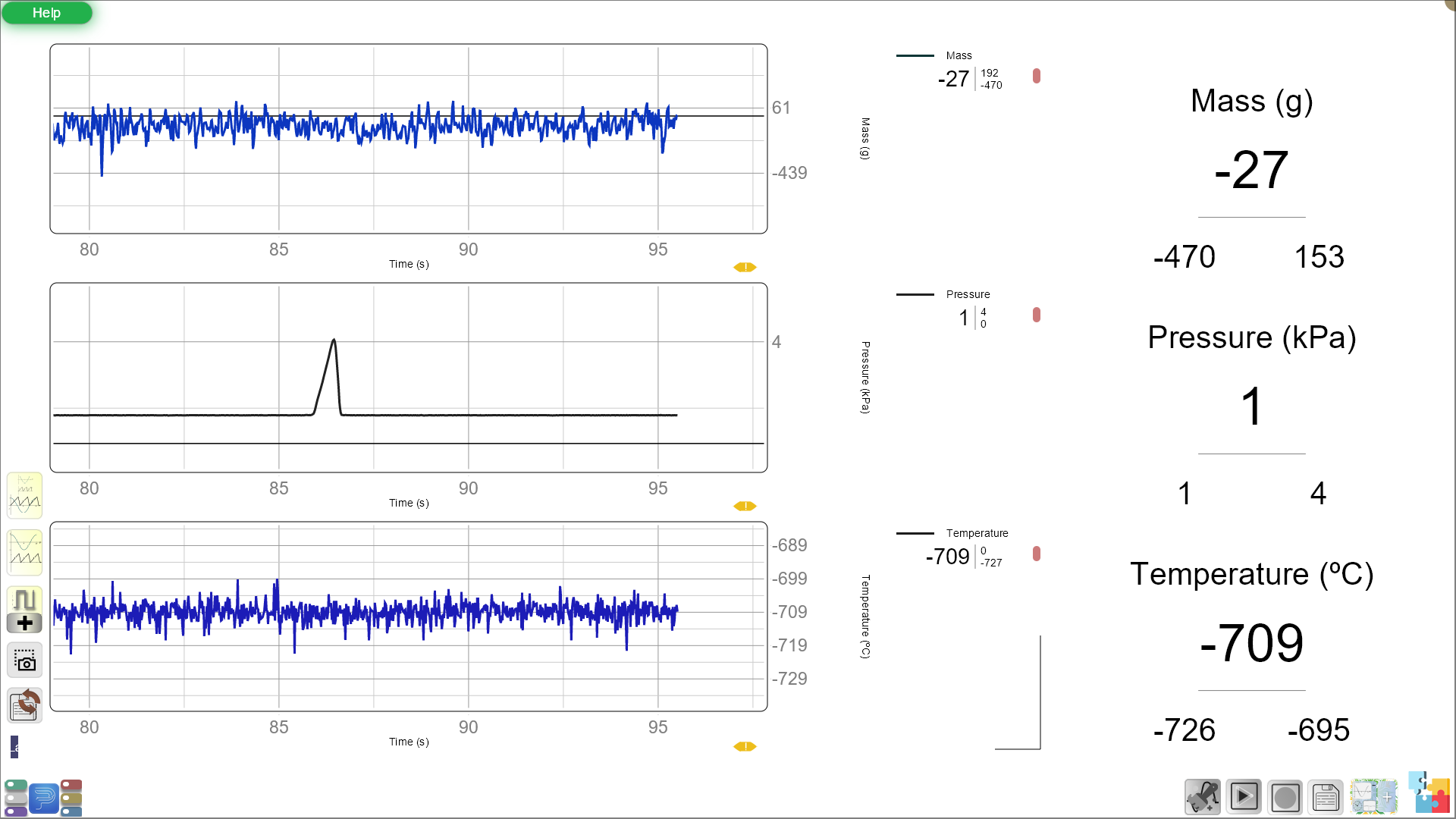
- Each group measures the initial mass of the container with reactants and records the initial pressure before starting the reaction.
Step 2: Conducting the Reaction and Recording Data
-
Running the Reaction:
- Add the diluted vinegar to the baking soda in the container, quickly seal the container, and start the timer.
- Record pressure readings at one-minute intervals for 3-5 minutes.
-
Observing Reaction Rates:
- You may ask:
“As the reaction happens, what do you notice about how quickly the pressure is changing at different temperatures?”
- Guide students to observe that the warm water bath likely speeds up the reaction, causing faster pressure increases.
Worksheet Section: Data Collection and Graphing:
Students will record and analyze their data on the worksheet.
Part 1: Data Collection Table
| Temperature Condition | Time (Seconds) | Pressure (atm) |
|---|---|---|
| Room Temperature | 0 | |
| 60 | ||
| 120 | ||
| 180 | ||
| Warm Water Bath | 0 | |
| 60 | ||
| 120 | ||
| 180 |
Part 2: Graphing Pressure Changes
Students plot time (x-axis) vs. pressure (y-axis) for both temperature conditions on the same graph.
- You may guide students:
“As you look at the graph, what do you notice about the slopes for each temperature condition? Which one is steeper, and what does that tell us about the reaction rate?”
Reflection and Follow-up Questions: (10-15 minutes)
- Analyzing Temperature Effects on Reaction Rate:
- You may ask:
“What does the steeper slope for the warm water bath tell us about how temperature affects reaction speed?”
- Guide students to understand that a steeper slope indicates a faster reaction rate at higher temperatures.
- Conservation of Mass in a Closed System:
- You may ask:
“Did the mass in the container change after the reaction? Why did it stay the same even though gas was produced? Why did we use diluted vinegar?”
- Reinforce that because the reaction was in a closed system, the mass remains constant even though pressure increased.
- Experimental Uncertainty and Error Discussion:
- You may ask:
“Could there have been any small sources of error in our experiment? For example, what if a tiny bit of gas escaped before sealing the container?”
- Briefly explain uncertainty as natural, small variations in measurements that can affect data slightly.
- Real-Life Connection:
- You may ask:
“Why is it important to control reaction rates in things like cooking or in safety systems like airbags?”
- Highlight that controlling reaction rates and understanding gas production is crucial in fields like food science, engineering, and safety design.
Summary and Wrap-Up: (5 minutes)
- Summarize Key Takeaways:
“Today, we learned how temperature affects reaction rates and saw that in a closed system, the total mass stays the same. These principles help scientists and engineers control reactions in many real-world applications.”
Glossary
- Conservation of Mass: The principle that the total mass in a closed system remains constant during a chemical reaction.
- Reaction Rate: The speed at which reactants are converted to products in a chemical reaction.
- Closed System: A system where no mass enters or leaves during a reaction.
- Experimental Uncertainty: Small variations or possible errors in measurements that affect accuracy.