Session 6: Terrain Testers – Movement on Different Surfaces
Duration: 50-60 minutes
Architect: Muhammad Bilal
Equipment Required:
- M3D Robotics kit (including M3D Go, its attachments, and necessary connections).
- Laptops with Scratch pre-installed.
- Paper and pencils for students to document their discoveries and ideas.
- Markers and small obstacles for robot navigation.
Learning Objectives:
- Understand how different surfaces (e.g., carpet, tile) affect the movement of the robot.
- Measure and compare the distances traveled by the robot on various surfaces.
- Experiment with inclined and declined surfaces and observe how slopes and obstacles affect the robot’s performance.
- Develop critical thinking and problem-solving skills through hands-on experimentation.
Resources:
Scratch Code File:
Grade 2 Session 6.sb3 (3.4 MB)
1. Introduction to Surfaces and Robot Movement (10 minutes)
Activity:
Introduce students to the idea that different surfaces can affect how a robot moves. Discuss surfaces they encounter daily, like carpet, tile, grass, or smooth floors.
Teacher’s Role:
Explain that robots may move faster or slower depending on the surface and that today they will investigate how their robot performs on different terrains.
Instructions:
Initiate a discussion with the students on how they encounter different surfaces in their daily routine. You may say:
“Think about how it feels when you run on smooth tile compared to thick carpet or even grass. We can feel some change in our movement. Well, our robots face the same challenges! Today, we’ll test how different surfaces—like carpet and tile—affect how far and fast our robots move. We’ll even throw in some extra challenges like hills or obstacles, and see how our robots handle them!”
2. Measuring Distance on Different Surfaces (15 minutes)
Activity:
Students will measure how far the robot travels on different surfaces. The goal is to see how the terrain impacts the robot’s speed and distance traveled.
Instructions:
Students will use the simple “Move _ Steps” block to make the robot move.
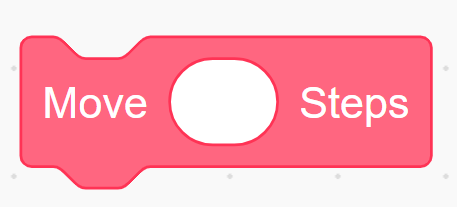
- Set Up the Surfaces:
You may start the discussion as:
“We’ll start by measuring how far the robot moves on a flat surface like tile, a book etc. then compare it to how it moves on carpet or other surfaces.”
- Students will set up testing areas on different surfaces (e.g., carpet, tile).
- Measure the Distance:
Encourage them to test the robot on different surfaces.
“Let’s drive the robot straight across each surface the same number of steps and measure how far it goes. Write down the distances for each surface.”
- Students will use a ruler or tape measure to record the distance traveled on each surface.
- Record Observations:
- Students will note how the robot’s speed or behavior changes based on the surface (e.g., slower on carpet, faster on tile).
Teacher’s Role:
Help students measure and record distances accurately. Encourage them to observe how the robot’s movement changes on different surfaces and guide them through the comparison.
3. Experimenting with Inclined/Declined Surfaces and Obstacles (20 minutes)
Activity:
Students will experiment with inclined and declined surfaces to see how gravity and slope affect the robot’s movement. They’ll also add small obstacles like pens or rubbers to observe whether the robot gets stuck or passes over them.
Instructions:
- Setting Up Inclines:
You can start with:
“Let’s see what happens when our robot moves up or down a slope. Does it struggle to go up? Does it speed up going down?”
- Students will create inclines/declines using books or ramps and observe how the robot moves.
- Encourage them to change the incline height and see how that affects the behavior of the robot.
- Adding Obstacles:
You can make it more interesting by adding obstacles:
“What happens when we add obstacles in the robot’s path? Does it get stuck or move over them?”
- Place small objects like pens or rubbers in the robot’s path and see how it navigates them.
- Record and Compare:
- Students will note any changes in how far or fast the robot travels on inclines and when encountering obstacles.
Teacher’s Role:
Guide students through setting up inclines and obstacles, ensuring they observe how the robot’s performance changes. Help them think critically about why the robot reacts differently on various surfaces and challenges.
4. Group Discussion and Comparison (10 minutes)
Activity:
Students will come together to compare their findings from different surfaces, inclines, and obstacles. They will discuss which surfaces slowed the robot down, which made it faster, and how it handled challenges.
Instructions:
- You may start a discussion with the students by saying:
“Let’s share what we’ve learned! Did your robot move faster or slower on carpet compared to tile? How did it handle going up a slope or over an obstacle?”
- Guide students to compare their results and think about why different surfaces or obstacles affected the robot’s movement.
Teacher’s Role:
Facilitate the group discussion, helping students compare their results and draw conclusions about surface types and obstacles. Encourage them to think about how surfaces affect real-life movement, like cars driving on roads or bikes on hills.
5. Reflection and Conclusion (5 minutes)
Activity:
Wrap up the session with a reflection on what students found most interesting or challenging.
Reflection Questions:
- “Which surface slowed down the robot the most?”
- Why does the movement change on different surfaces?
- “What surprised you about how the robot handled obstacles or hills?”
- “What surface do you think the robot would move fastest on?”
Teacher’s Role:
Guide students in reflecting on their observations, helping them connect the experiment to the real world and encouraging curiosity for future challenges.
Learning Outcome:
By the end of the session, students will understand how different surfaces, inclines, and obstacles impact the robot’s movement. They will have gained experience in measuring and comparing the robot’s performance under various conditions.