Grade 3 Session 5: “Breath and Beat: Exploring Pulse and CO₂”
Session Architect: Aleeza Ayaz - Markhor 3D
Session Length: 50-60 Minutes
Session Overview:
In this session, students will explore the relationship between breathing, heart rate, and physical activity. They will use MeasureLab’s pulse and CO₂ sensors to measure their heart rate and the amount of CO₂ they exhale, both at rest and after exercise. By engaging in activities like jumping, they will observe how physical activity influences their pulse and CO₂ levels. The session also introduces the concept of patterns and predictions as students explore how different intensities and durations of movement impact their bodies. Through hands-on exploration and interactive discussions, students will develop a deeper understanding of how the body responds to different activities.
Learning Objectives:
By the end of this session, students will:
- Understand how heart rate and breathing are connected.
- Measure and compare pulse rates and CO₂ levels at rest and after physical activity.
- Recognize how movement intensity and duration affect heart rate and CO₂ output.
- Observe patterns in data and make predictions based on their experiences.
- Understand the role of energy and oxygen in the body’s response to exercise.
Equipment Required:
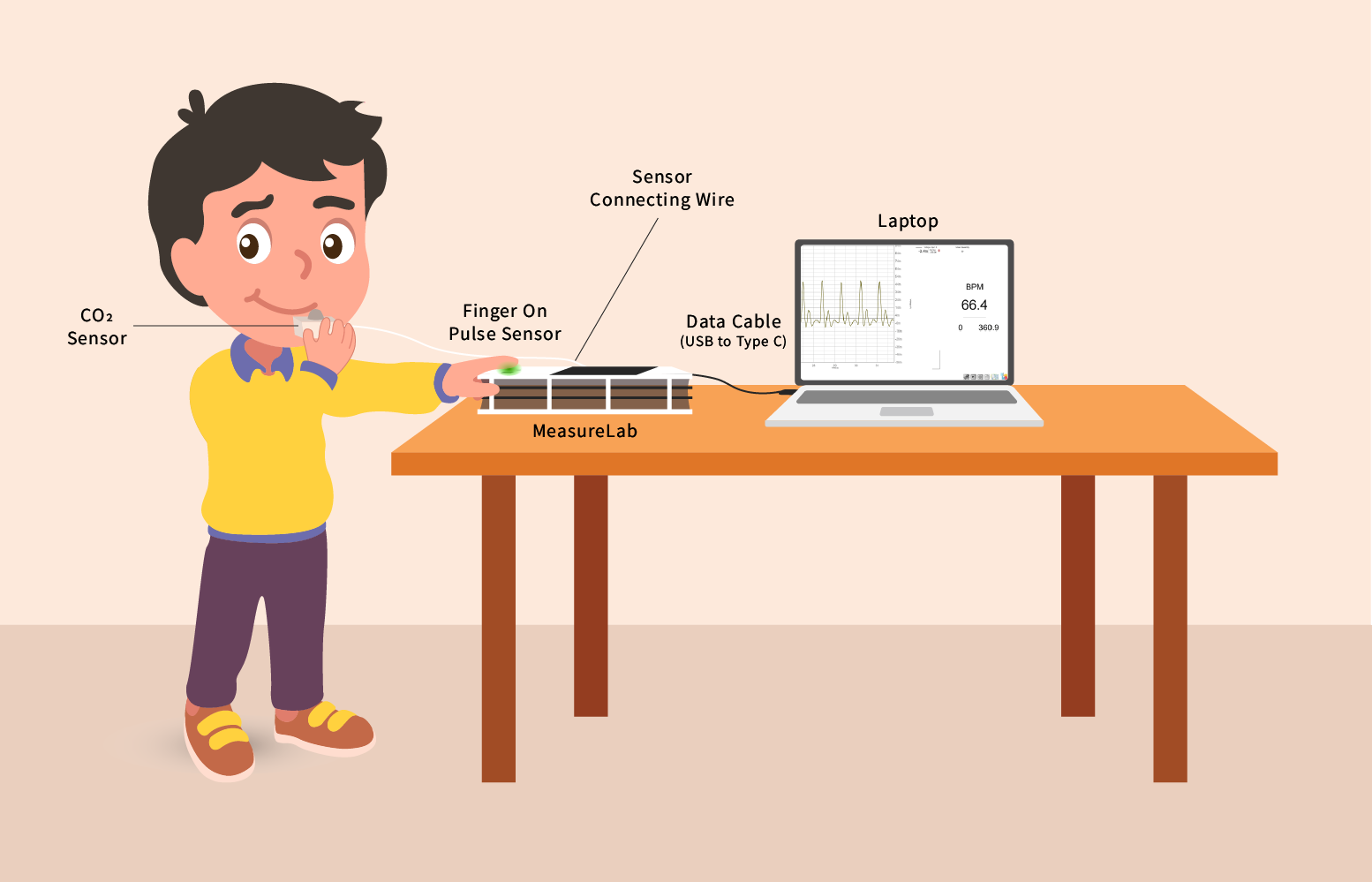
- MeasureLab with pulse sensor and CO₂ sensor connected to a laptop or PC for real-time data display.
- Worksheet for recording predictions, measurements, and observations.
- Pens, pencils, and markers for recording data and drawing patterns.
Teaching Aids:
- Projector (optional, for displaying live pulse and CO₂ data).
- Whiteboard or chart paper to illustrate key concepts.
Teacher Resource:
Session File: ML36.plf (59.1 KB)
Preparation:
This step has to be done before the session on each workstation/apparatus by the teacher/session instructor:
- Make sure that each computer has Physlogger installed and can detect the Measrelab when connected to it using the provided cable.
- Each MeasureLab should have access to a power outlet for sensors that require external power. For this session, built-in Heart Rate Sensor and CO₂ sensor will be used which require an external power source. The CO₂ Sensor has to be connected in the following dedicated port:

- Launch the Physlogger application and load the session file provided in the resources section.
Your setup will look something like this:
1. Introduction and Discussion (10-15 minutes)
Engagement Question:
Start with a lively question to pique their curiosity:
- “Okay, everyone, take a big, deep breath with me… and let it out slowly. Now, let’s do it again! What do you think is happening inside our bodies when we breathe like that?”
Encourage Fun Guesses:
- Allow students to offer imaginative guesses like “our lungs get bigger,” “our body fills up with air,” or even “we become balloons!” Acknowledge each guess to keep them engaged and curious.
Follow-Up Question:
Ask:
“Now, if breathing brings something into our body, do you think there’s anything else that happens? Is there something else inside us that might also be affected?”
Gently guide them toward recognizing that breathing is linked to the heart and its rhythm.
The Connection Between Heart and Breathing:
Explain with enthusiasm:
“You’re right! Our heart and our breathing are best friends. When we breathe in, oxygen fills our lungs and goes into our blood, and our heart pumps that oxygen-filled blood all over our body. So, they work together to keep us moving and strong!”
Exploring Energy:
Ask:
“What do you think happens to our heart and our breathing when we start moving around a lot—like when we’re playing a game or running? Why do you think that is?”
Let students share answers like “we need more energy,” “we get tired,” or “we breathe faster.”
Setting the Scene for Experimentation:
Wrap up the discussion with:
“Today, we’re going to become scientists and explore how our heart and breathing change when we’re at rest and after we exercise! We’ll also be measuring something else—CO₂. That’s a part of the air we breathe out, and it changes when we’re moving, too!”
Prediction Prompt:
“What do you think will happen to our heart rate and CO₂ when we exercise? Will they change a lot, a little, or stay the same? Let’s write down our guesses before we begin!”
Have students jot down their predictions on their worksheets, setting them up to compare later.
2. Measuring Resting Heart Rate and CO₂ Levels (10 minutes)
Step 1: Setting Up the Sensors
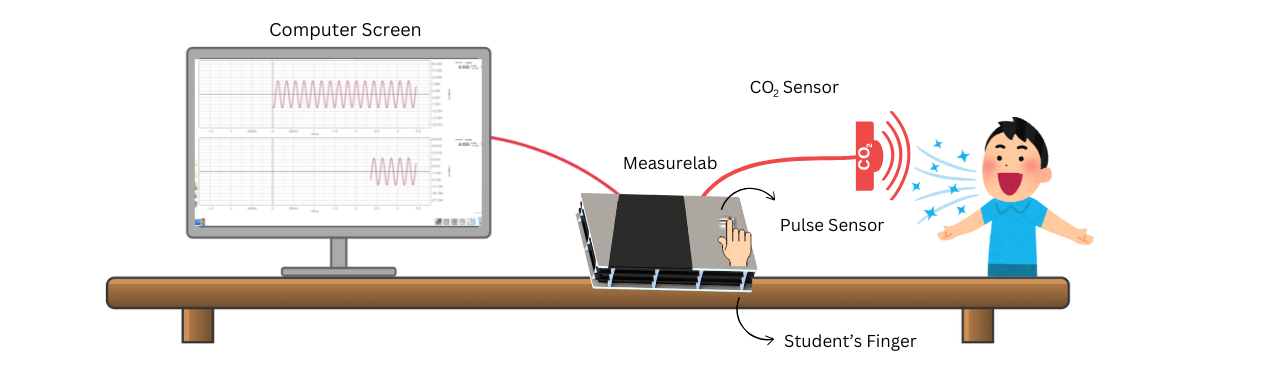
- Show students the pulse sensor and CO₂ sensor, explaining how each one works.
“The pulse sensor will help us see how fast our heart is beating, and the CO₂ sensor will measure how much CO₂, or carbon dioxide, we breathe out. This is a gas our body makes, and we can learn a lot about how hard our body is working by measuring it!”
Step 2: Measuring Resting Rates
- Have each student place their finger on the pulse sensor and breathe normally, observing their heart rate on the live plot.
- Then, have them exhale into the CO₂ sensor to measure their resting CO₂ levels.
- Students record these values on their worksheets.
Discussion Prompt:
“What do you see on the screen? How fast is your heart beating? And how much CO₂ are you breathing out? This is our resting rate—let’s see how different it looks after we exercise!”
3. Hands-On Activity: Exercise and Measuring Changes (20 minutes)
Step 1: First Exercise – 20 Seconds of Jumping
- Ask the students to stand up and jump on the spot for 20 seconds.
- Immediately after, they measure their heart rate and CO₂ levels again and record the results.
Step 2: Adding a Prediction Phase
- Before moving on to the next jumping round, ask:
“What do you think will happen if we jump for even longer, like 40 seconds? Do you think our heart and breathing will change a lot, a little, or stay the same?”
- Have them jot down their predictions to see how close they are afterward.
Step 3: Second Exercise – 40 Seconds of Jumping
- Students jump for 40 seconds, then measure and record their heart rate and CO₂ levels.
Step 4: Final Exercise – 60 Seconds of Jumping
- Students rest for one minute to let their heart rate stabilize.
- They jump for 60 seconds, measure, and record their heart rate and CO₂ levels.
Data Table Example:
| Activity | Heart Rate (BPM) | CO₂ Level | Observations |
|---|---|---|---|
| Resting | |||
| Jumping - 20 sec | |||
| Jumping - 40 sec | |||
| Jumping - 60 sec |
Discussion and Pattern Recognition:
Gather the class and ask:
“What do you notice about how your heart rate and CO₂ changed with each round of jumping? Did they go up, down, or stay the same?”
Guide them to recognize a pattern: as the exercise duration increased, so did their heart rate and CO₂ levels.
Drawing Patterns:
- Have students draw a simple line graph or pattern on their worksheets to visualize how their heart rate and CO₂ levels increased with longer exercise durations.
4. Breath-Holding Experiment (10 minutes)
Introduction to Breath-Holding:
Ask:
“What do you think would happen to your heart rate if you tried holding your breath? Would it go up, down, or stay the same?”
Let students guess and write down their predictions.
Measurement Setup:
- Each student places their finger on the pulse sensor, then holds their breath for as long as they comfortably can (no need to hold it for too long).
- As they hold their breath, the group monitors their heart rate to see any changes.
Data Recording and Observation:
| Student | Breath-Hold Duration | Heart Rate Change | Observations |
|---|---|---|---|
| Student 1 | |||
| Student 2 |
Discussion Questions:
“What happened to your heart rate when you held your breath? Did you feel your heart beating differently than after jumping?”
Guide students to observe any small changes or patterns, discussing why the body reacts to breath-holding.
Reflection on Energy and Breathing:
Explain that holding our breath can make our heart slow down slightly as it conserves energy. This connects the experiment back to how the body adapts based on its oxygen needs.
5. Reflection and Wrap-Up (5-10 minutes)
Discussion Questions:
- “What did we learn today about how exercise changes our heart rate and breathing?”
- “Why do you think our body needs more oxygen and produces more CO₂ when we exercise?”
Key Takeaway:
- “Our bodies need more energy when we move a lot, so our heart pumps faster, and we breathe out more CO₂. This session helped us see how our body responds to different activities!”
Worksheet Reflection:
- Students can write down one new thing they learned, or something that surprised them, about how their body works during exercise.
- Reflection Prompt: “What do you think happens to your heart rate when you’re very still or asleep?”
Glossary:
- Pulse Rate: The number of times your heart beats in a minute.
- CO₂ Level: The amount of carbon dioxide you breathe out
- Energy: The power our body needs to move and stay active.
- Pattern: A repeated way that something happens (like heart rate going up with more activity).