Grade 8 - Session 6: Buoyancy with Custom Objects
Session Architect: Aleeza Ayaz - Markhor3D
Session Length: 50-60 minutes
Learning Objectives
In this session, students will:
- Understand buoyancy and Archimedes’ Principle through hands-on experimentation.
- Measure the volume of displaced liquid and relate it to the concept of buoyant force.
- Calculate the density of objects and compare it to the density of the liquid to determine buoyancy.
- Explore how different shapes and densities of objects affect buoyancy across various liquids.
- Record measurements, graph results, and interpret trends to understand proportional relationships.
Teacher Resource
Session File: ML86.plf (57.7 KB)
Equipment Required
- MeasureLab with a built-in load cell
- Custom-built objects of different materials and shapes
- Beakers for measuring displaced water
- Containers filled with various liquids (e.g., water, saltwater, oil)
- Graduated cylinders for measuring displaced liquid
- Worksheet for recording data and analyzing findings
- Graph paper or digital plotting tool
- Pens, pencils, markers, etc.
Teaching Aids
- Visual aids: Diagrams of buoyancy, Archimedes’ Principle, and density
- Projector (optional) to display live data and example graphs
- Pre-cut or 3D printed custom objects to illustrate variations in shape and material
Preparation:
This step has to be done before the session on each workstation/apparatus by the teacher/session instructor:
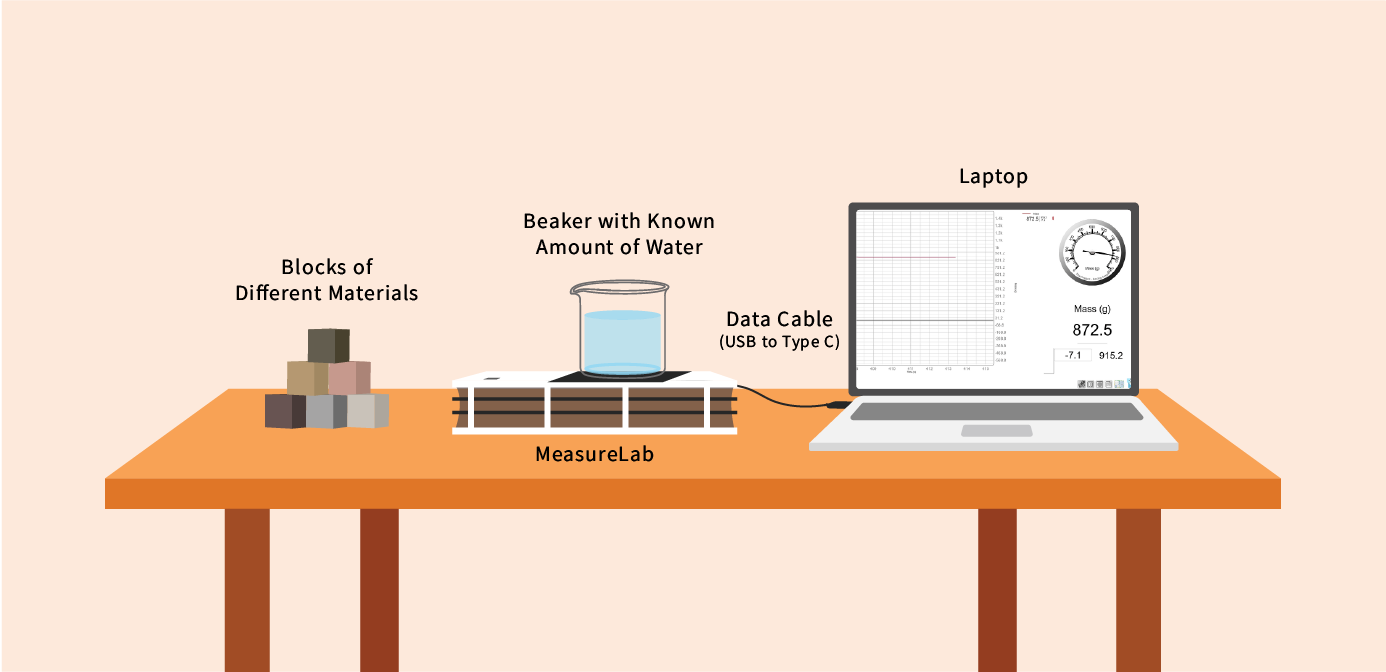
- Make sure that each computer has Physlogger installed and can detect the Measrelab when connected to it using the provided cable.
- Each Measurelab should have access to a power outlet for sensors that require external power. For this session, we will use Loadcell which does not require external power to be connected.
- Launch the Physlogger application and load the session file provided in the resources section.
Your setup will look something like this:
Introduction and Hands-On Exploration: (35 minutes)
Engaging Students with Everyday Examples of Buoyancy
- You may start by asking:
“Have you ever noticed that when a swimmer holds a deep breath, they float better? Why do you think this happens?”
- Let students share their ideas, connecting their responses to increased body volume and reduced density.
Recalling Archimedes’ Principle and Introducing Density
- You may ask:
“What do you think happens when we put an object in water? Does the water push back?”
-
Guide students to understand that water pushes up on objects, causing some to float and others to sink.
-
You may explain:
“Archimedes’ Principle tells us that the buoyant force on an object is equal to the weight of the liquid it displaces. The density of an object—its mass per unit volume—also affects whether it will float.”
Demonstration with Objects of Different Densities
Show a dense object (e.g., metal cube) and a less dense object (e.g., plastic block).
- You may ask:
“Why do you think the dense metal sinks while the less dense plastic floats?”
- Explain:
“The plastic has a lower density, so it displaces enough water to balance its weight and float. The metal, with a higher density, cannot displace enough water to counter its weight. That’s because the volume is small, but the mass is large. The water displaced due to the volume is not enough.”
What is Density?
- You may clarify:
“Density is the amount of mass per unit volume. Objects with lower density than water will float, while those with higher density will sink.”
Step 1: Measuring Object Weight and Volume Displacement
Measuring Object Weight (Before Submersion):
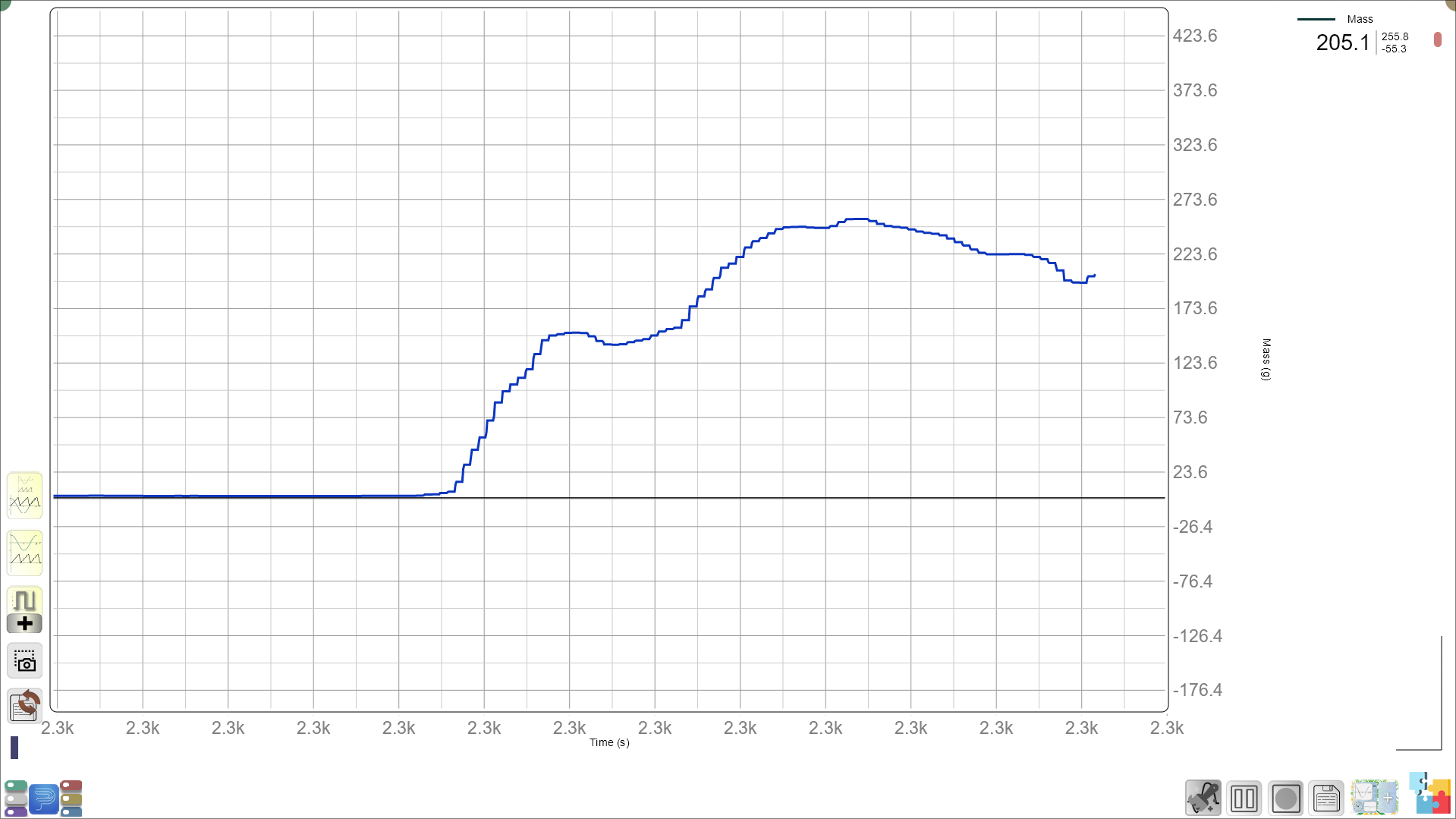
- Weigh each object on the load cell to determine its weight in air. Record on the worksheet.
Measuring Volume of Displaced Liquid (Displacement)
- Place the object in the beaker filled with a known volume of liquid.
- Measure how much liquid is displaced by noting the new water level.
- Record the volume of displaced water in each liquid type.
Data Table:
| Object | Liquid Type | Initial Water Level (mL) | Final Water Level (mL) | Displaced Volume (mL) | Weight in Air (g) | Weight of Displaced Liquid (g) | Floats or Sinks |
|---|---|---|---|---|---|---|---|
| Object 1 | Water | ||||||
| Saltwater | |||||||
| Oil | |||||||
| Object 2 | Water | ||||||
| Saltwater | |||||||
| Oil |
Step 2: Testing Buoyancy in Different Liquids
Submerge Each Object in Three Liquids
- Record data for each object in water, saltwater, and oil. Note any changes in the floating behavior and the volume of displaced liquid for each liquid.
You may ask during testing:
- “How did the object’s behavior change across different liquids?”
- “Did it float or sink more easily in one liquid over the others?”
Calculating Buoyant Force and Analyzing Findings
- Simplify the explanation:
“According to Archimedes’ Principle, the buoyant force on an object equals the weight of the liquid displaced. So, the heavier the displaced liquid, the more buoyant force pushes back.”
Graphing Activity and Analysis: (15 minutes)
Plotting Displaced Volume vs. Buoyant Force for Each Liquid on the Same Graph
-
Graph Setup:
- Use graph paper or a digital plot to set Displaced Volume (x-axis) and Buoyant Force (y-axis).
- Create separate lines for each liquid (water, saltwater, and oil) for the same object, using different colors.
-
Analyzing the Graphs:
- After plotting, guide students to observe and discuss:
“How does the buoyant force change as the displaced volume increases? Is there a trend across the liquids?”
“What does the slope of each line suggest about the relationship between liquid density and buoyant force?”
Sample Reflection Questions
- “Which liquid provided the greatest buoyant force for the same displaced volume?”
- “What conclusions can you draw about the relationship between density, buoyant force, and displaced volume?”
Reflection and Wrap-Up: (5-10 minutes)
- Summarize Findings:
“Today, we learned that the buoyant force depends on the volume of displaced liquid and its density. We observed that denser liquids like saltwater provide greater buoyant force, helping objects float more easily.”
- Connect to Real-World Applications:
“This principle explains why people float more easily in the ocean than in a pool—it’s all due to the denser, saltier water supporting more weight.”
Glossary
- Buoyant Force: The upward force that keeps objects afloat in a liquid.
- Archimedes’ Principle: The rule that the buoyant force is equal to the weight of the liquid displaced by the object.
- Displacement: The amount of fluid pushed aside by an object.
- Density: Mass per unit volume, affecting whether an object floats or sinks in a fluid.